Numerical Weather Prediction+Data Assimilation
Eliminating Damage from Torrential Rain
Through Meteorological Data Science!
Deep LearningAIDisaster PredictionQuantum ComputingAnnealingGlobal Precipitation Map
Preventing the Formation of Linear Precipitation Bands
You may have heard the meteorological term “linear precipitation bands.” One after another, rain clouds form in a line and remain over a specific area, bringing localized torrential rain and causing disasters such as flooding and landslides.
Such meteorological disasters have clearly increased over the past decade, and the total damage is estimated to be as high as 1–2 trillion yen per year.
As part of the national project “MOONSHOT*,” we are working to use data science to control the weather and eliminate damage caused by torrential rain.
In Japan, weather systems generally move from west to east. In the mechanism behind linear precipitation bands, water vapor evaporated over the East China Sea flows eastward in the upper atmosphere, makes landfall in places such as Kyushu and Shikoku, forms cumulonimbus clouds, and brings rainfall.
If we can intervene in this large volume of water vapor and make it fall as rain over the ocean before it approaches the Japanese archipelago, we should be able to avoid torrential-rain disasters.
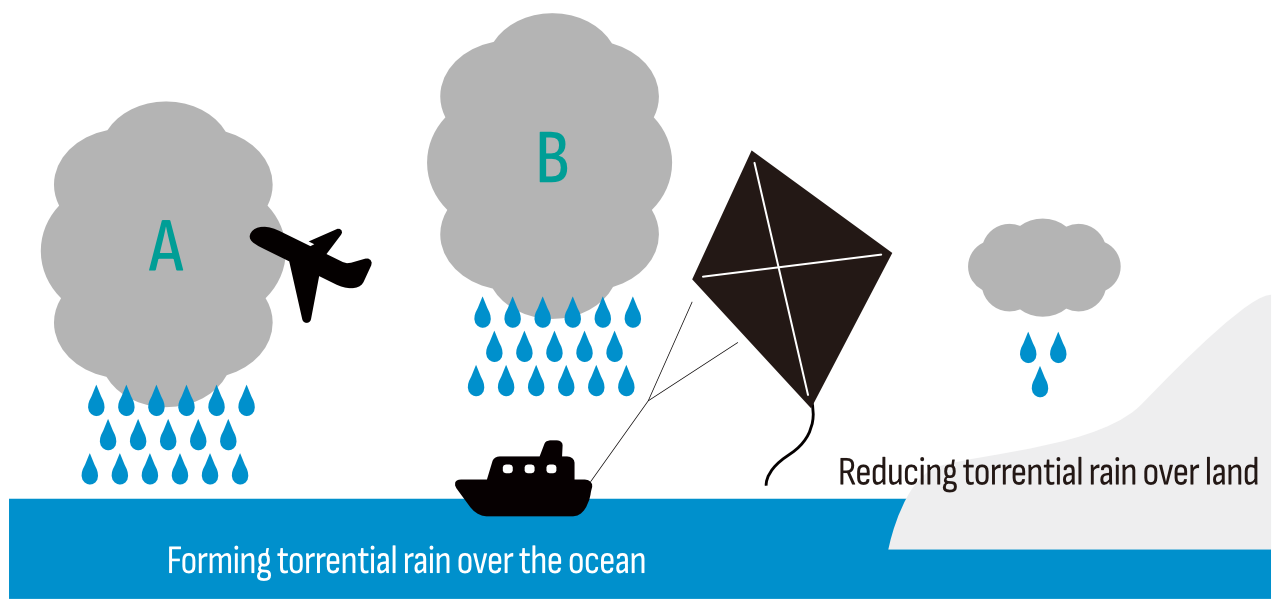
A: By scattering “rain seeds,” such as dry ice–like particles, into the water vapor over the ocean and inducing rainfall artificially, precipitation over land is reduced. This is also called “cloud seeding.”
B: By installing large kites over the ocean to generate updrafts, cumulonimbus clouds are created artificially and rainfall is induced.
Tips
MOONSHOT
A large-scale national R&D program established with the concept of creating disruptive innovations originating in Japan and conducting ambitious, challenge-driven research and development based on bold ideas, in order to address various issues such as a declining and aging population, global warming, and large-scale disasters.
Methods Under Consideration
Possible methods include combining several approaches, such as seeding—dispersing particles in the upper atmosphere that help water-vapor droplets coalesce—and installing enormous kites about 300 meters high over the ocean to create updrafts and induce rainfall.
At present, we are building numerical simulation models to predict the weather and testing various ideas on computers—for example, where rain should be made to fall and whether placing kites would truly be effective.
“Data Assimilation” to Improve Prediction Accuracy
Even if we build a numerical simulation model and run calculations, it is meaningless if the results diverge from reality. That is where the data-science technique called “data assimilation†” becomes important.
By continuously incorporating real observational data into the calculations, we bring the simulation results closer to reality.
Data assimilation has been used in weather forecasting for more than 50 years, but accuracy has improved rapidly with the use of AI and big data and advances in supercomputers.
It is now used in a variety of fields—for example, predicting COVID-19 infections and conducting control experiments for space rockets.
Tips
Data Assimilation
A method for improving forecast accuracy by incorporating observational data—such as from meteorological satellites and radar—into a simulation model. This makes it possible to forecast conditions in locations where observations are difficult.
Developing People Who Can Use Data Science as a Tool
Data science is one form of mathematics. Mathematics is itself a subject of research, but at the same time it can also serve as a tool for studying various natural phenomena and social issues. The same is true of data science.
For example, developing supercomputers for advanced computation is also part of data science, and at the same time data science is a universal discipline that can be used to solve the many social problems that exist in the world.
In the future, data science will become essential knowledge and skills. Here at Chiba University, there is a meaningful place to learn for both those who want to study what data science is and those who want to use data science to solve social issues.
If you feel—even vaguely—that “this sounds interesting,” you should be able to spend four years at this faculty and grow.
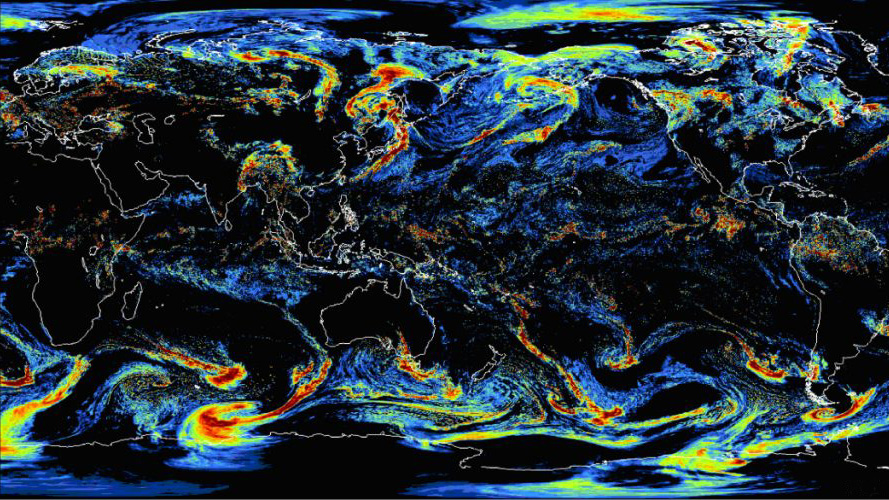
This is a map that simulates precipitation conditions on a global scale. We are working to create a highly accurate global map of precipitation conditions by collecting observational data from satellites and ground-based observations and integrating them using data-science techniques such as data assimilation and machine learning.
Profile
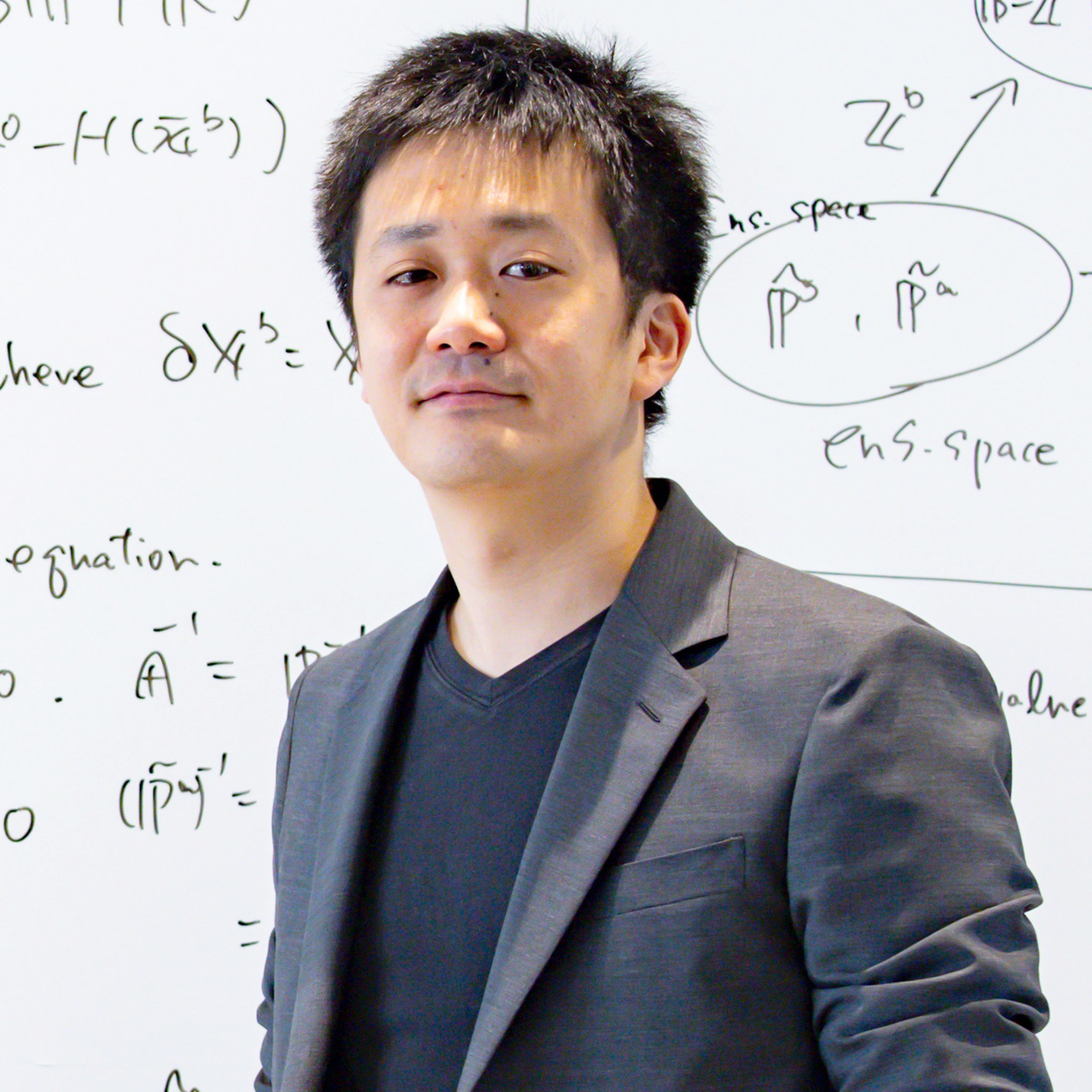
Prof. Shunji KOTSUKI
Professor, Faculty of Informatics, Chiba University / Institute for Advanced Academic Research, Chiba University. He graduated from the Undergraduate School of Civil, Environmental and Resources Engineering, Kyoto University in 2009 and completed the Graduate School of Engineering at the same university in 2013. After serving as a Special Postdoctoral Researcher and then a Researcher at the RIKEN Advanced Institute for Computational Science, he became an Associate Professor at the Center for Environmental Remote Sensing, Chiba University. He has held his current position since 2022. Ph.D. (Engineering).

View Another Research
Improving AI Accuracy and Nurturing It into a Trustworthy Partner
Assoc. Prof. Hiroshi KERA
Developing a Camera That Can Capture What Cannot Be Seen
Assoc. Prof. Hiroyuki KUBO
Eliminating Damage from Torrential Rain Through Meteorological Data Science!
Prof. Shunji KOTSUKI
Using Human Data to Support Longer, Healthier Lives
Prof. Ryoko KATAGIRI
How Far Will AI Evolve in Distinguishing Dogs from Cats?
Prof. Kazuhiko KAWAMOTO
Aiming for a New Information and Communication Society with Energy and Environmental Issues in Mind!
Prof. Hiroo SEKIYA